Salt water vs chlorine pool: the five-year view
2026-09-04 · 8 min read
A salt pool is a chlorine pool that makes its own chlorine. The comparison is not sanitiser versus sanitiser — it is a capital cost and a different maintenance rhythm against jugs in the truck.
Best overall
Salt
Steadier chlorine, better water feel, no jugs — if you accept cell replacement as a scheduled cost.
Best budget
Traditional chlorine
No cell, no controller, nothing to replace at year five.
Best for large pools
Salt
The labour saving scales with volume; so does the value of a steady residual.
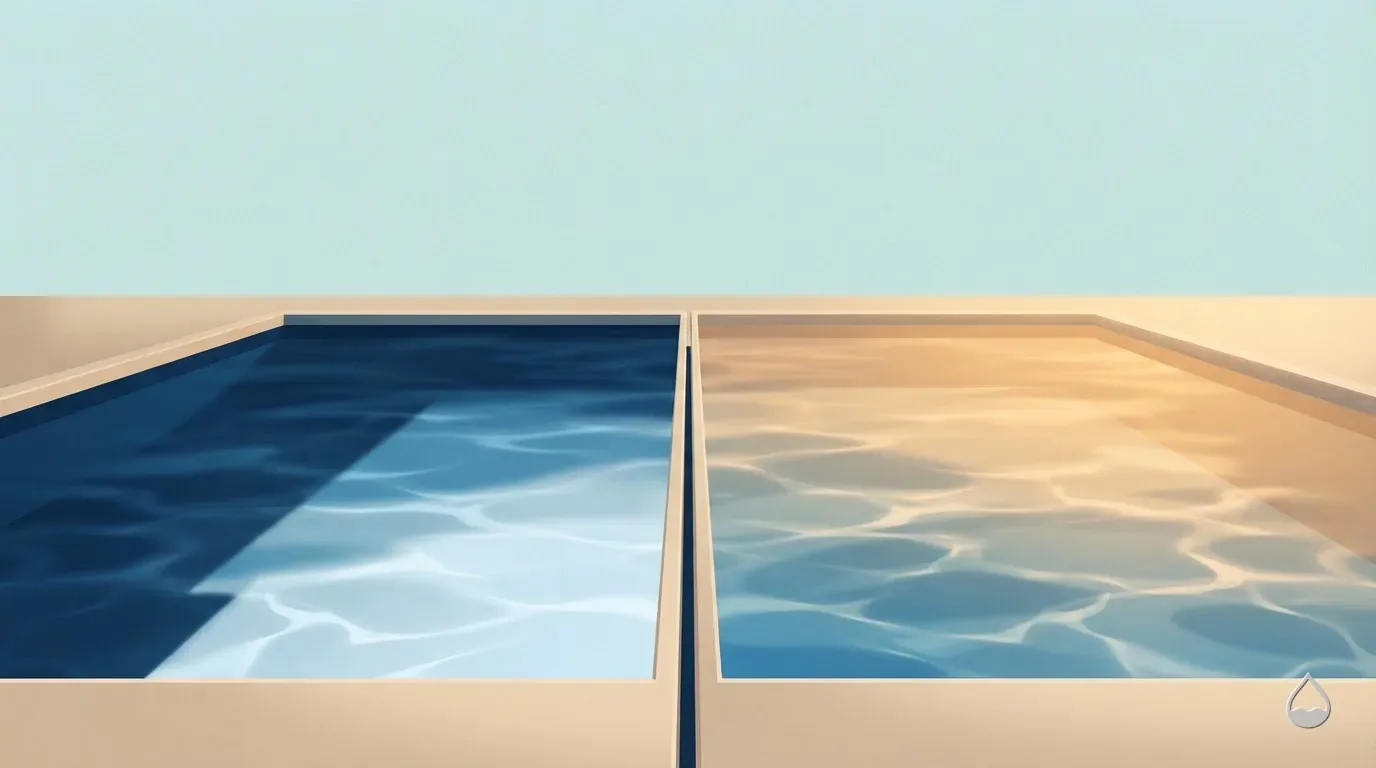
What actually differs over five years
Our pick — salt system
| Factor | Salt system | Traditional chlorine |
|---|---|---|
| Up-front | Cell, controller and install | None beyond a feeder |
| Consumable | Salt top-ups, cell replacement on hours | Chlorine, continuously |
| Chlorine residual | Steady, generated as the pump runs | Sawtooth between doses |
| pH drift | Upward — acid on most stops | Downward with tablets, flat with liquid |
| Stabiliser | Added deliberately, stays put | Climbs by itself if tablets are used |
| Water feel | Softer, less chlorine smell | Depends entirely on chloramine control |
| Corrosion risk | Real on some metals and stone | Lower |
| Failure mode | Cell scales or wears out | You run out of chlorine on a Friday |
Cell life
Measured in operating hours, not calendar years — run time is the variable.
The recurring job
Salt: acid, and cell inspection. Traditional: carrying and storing chlorine.
Same chemistry
Both end up as free chlorine in water; the WHO bands apply identically.
What a salt pool actually is
Dissolved salt, a cell in the return line, and electrolysis that splits it into chlorine. The water is not chlorine-free; it is chlorine-generating. Everything in the seven readings still applies, including the WHO band of 1 to 3 ppm free chlorine.
The maintenance nobody mentions at the sale
Salt cells push pH upward continuously, which means acid on most stops rather than the occasional correction. They scale in hard water and need inspecting — not scheduled acid-washing, which shortens their life; see the cell cleaning guide. And they stop producing when water is cold, which surprises owners every spring.
Where salt genuinely wins
A steady residual. A traditional pool sawtooths between doses — high after a visit, low before the next — while a cell generates whenever the pump runs, so the water sits in band more of the time. On a large pool that is also several fewer jugs a week in a truck, which is a real labour cost.
Where it does not
Salt is corrosive to some coping stones, natural stone decks, and older metal fittings — the damage is slow and unarguable once it appears. And the cell is a scheduled expense: budget for replacement rather than being surprised by it, because a pool with a dead cell is a pool with no sanitiser at all until it is replaced.
Converting an existing pool
Straightforward on most pools: add salt with the salt calculator, fit the cell and controller in the return line, and set the output. Check the deck and coping material first, and check whether stabiliser is already high — a cell will not fix a pool that cannot hold chlorine.
Buying checklist
- Read the cell’s own target salinity — do not use a generic ppm figure.
- Check coping and deck material for salt tolerance before converting.
- Budget cell replacement as a scheduled cost, not an emergency.
- Plan for acid on most stops, and test alkalinity monthly.
- Test stabiliser before converting; a cell cannot outrun high CYA.