Why alkalinity climbs
Three sources, mostly. Fill water in hard-water regions arrives high. Sodium bicarbonate added last season to fix a low reading over-shot. And cal-hypo shock, used weekly, drags both hardness and alkalinity upward over a summer. None of them announce themselves — you notice when pH will not stay down.
The problem with just adding acid
Acid lowers alkalinity and pH together. Pour in enough to move alkalinity 60 ppm and you will find pH somewhere near 6.8, which etches plaster and corrodes metal. The trick is not a different chemical; it is separating the two effects in time.
Never mix
Acid and chlorine products together make chlorine gas. Different visit, or hours apart with the pump running — no exceptions, no “it’s only a small amount”.
The column-and-aeration method
- Test alkalinity and pH properly, off a drop kit. Work out the dose — the calculator does the arithmetic and caps a single dose at 20 ppm.
- Turn the pump off and let the surface settle.
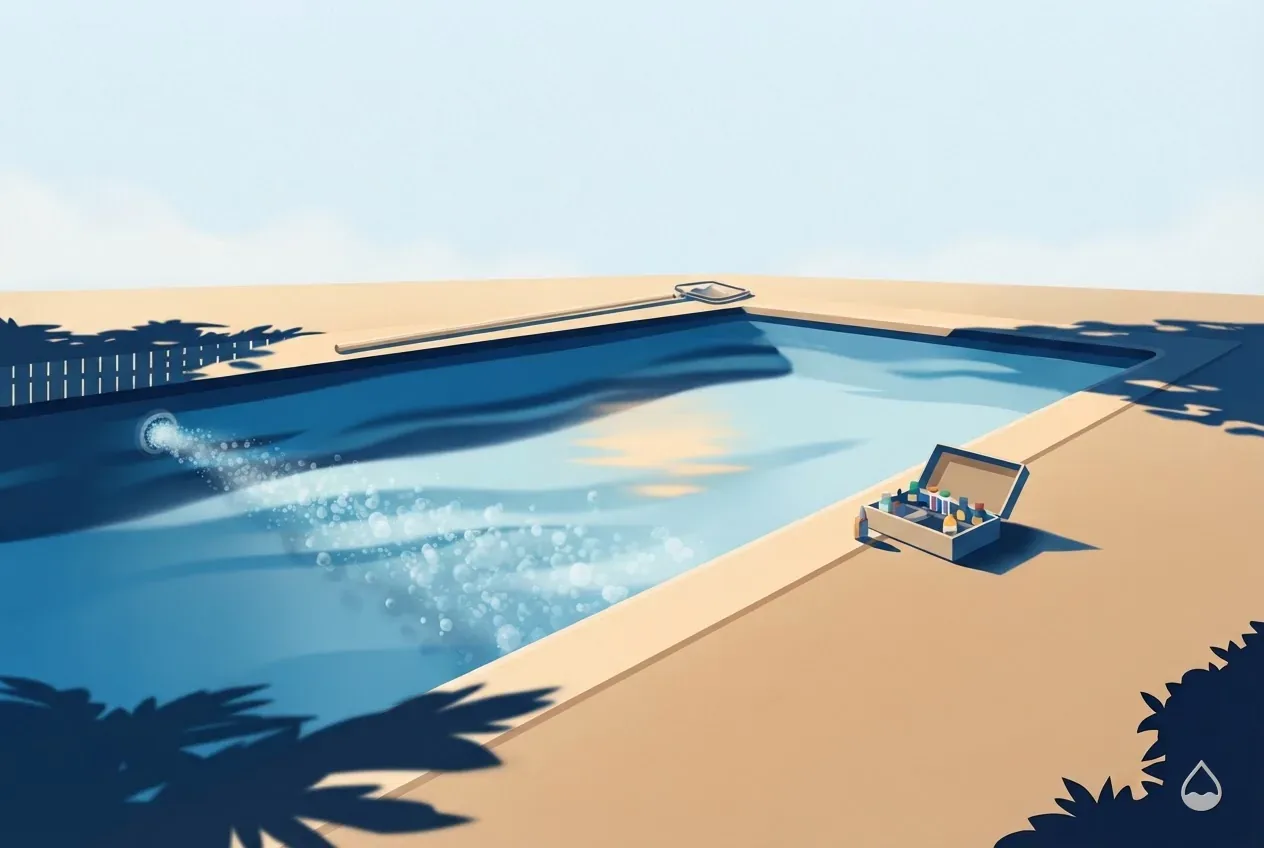
- Pour the acid in a slow column into the deepest point, one place, never spread across the pool.
- Leave it undisturbed for about thirty minutes. The acid works locally on the carbonate buffer instead of the whole body of water.
- Run the pump. Aerate if you can — a fountain, a spa jet, or returns angled upward.
- Re-test the next day. pH will have risen back toward band; alkalinity will not have.
That last step is the point of the whole exercise: aeration drives carbon dioxide out of the water, which lifts pH while leaving the alkalinity you just removed removed.
Staging a big correction
| Starting TA | Target | Doses | Acid per dose, 22k gal |
|---|---|---|---|
| 140 ppm | 100 ppm | 2 | ~28 fl oz |
| 180 ppm | 100 ppm | 4 | ~28 fl oz |
| 220 ppm | 100 ppm | 6 | ~28 fl oz |
One dose a day, re-testing between. A week is normal for a badly drifted pool and it beats a single dump that leaves pH at 6.6.
Where it goes wrong
Pouring with the pump running spreads the acid and treats the whole pool at once — which is exactly the pH crash you were avoiding. Testing an hour later reads a false low. And chasing pH back up with soda ash undoes the correction, because soda ash adds alkalinity straight back. Aerate instead; it is free.