
Check these three things first
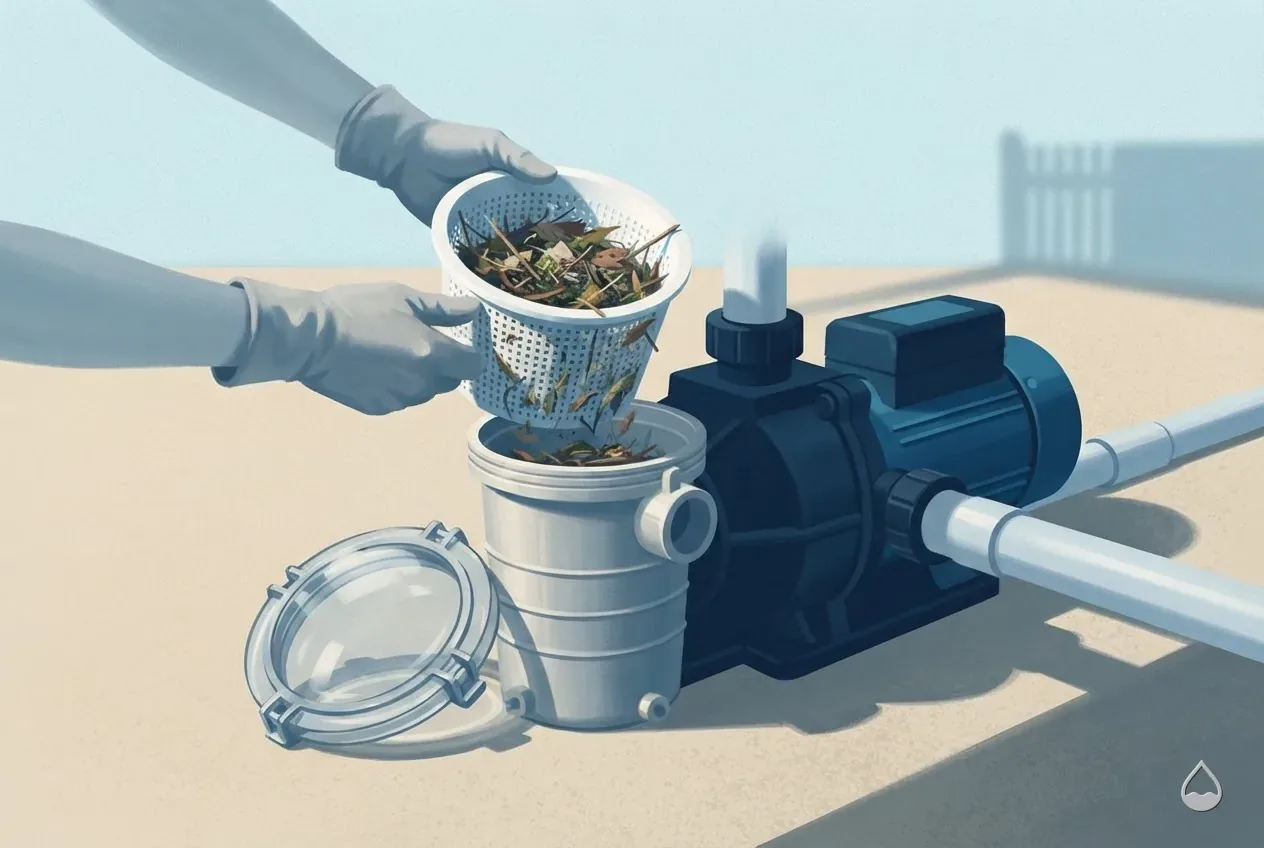
Before any diagnosis: is the water above the skimmer, is the pump basket clear, and is the lid o-ring seated and lubricated. A startling share of “dead pump” call-outs are one of those three, and all of them are free to fix.
Power off at the breaker
Not the timer, not the switch on the pad. Pool equipment sits in water and the breaker is the only thing you can trust.
It will not prime
A pump that spins but never fills its trap has an air leak somewhere on the suction side, which is everything between the pool and the impeller. Fill the trap by hand, start it, and watch: a steady stream of bubbles from a return jet means air is being drawn in, not vented out.
Work the suspects in order: the lid o-ring (dry, cracked or misaligned), the drain plugs, the union o-rings, then the valve stem seals. Only after those does it become a cracked suction line, which is a real repair rather than a five-minute one.
It hums but will not turn
Two candidates. A failed start capacitor is the common and cheap one — the motor hums, draws current, and will often start if you nudge the shaft (with the breaker off, then on). A seized shaft is the other: if the shaft will not turn by hand at all, the bearings or the seal have welded it, and you are into motor territory.
Capacitors hold a charge after the power is off. Discharge one before touching the terminals, or hand the job to an electrician — this is the point where “have a go” stops being sensible.
It leaks
| Where it drips | What it is | Difficulty |
|---|---|---|
| Between motor and wet end | Mechanical seal | Moderate — pump comes apart |
| At a union | O-ring | Easy |
| From the lid | Lid o-ring or cracked lid | Easy |
| From the housing itself | Cracked volute — often a freeze | Replace the wet end |
A shaft-seal leak is urgent in a way an o-ring drip is not: water tracks along the shaft into the motor bearings, and a seal ignored for a month becomes a motor.
It screams or grinds
A rising metallic scream is bearings. It is a genuine repair on a large motor and a false economy on a small one, because bearing replacement is labour-heavy. A rattle that changes with flow is more likely debris in the impeller; a gravelly noise that rises and falls is cavitation, which is a suction restriction — usually a clogged basket, sometimes a pump too big for the pipe.
Repair or replace
The honest line is arithmetic, not sentiment. Add the parts, then the labour at your real hourly cost — the US median for general maintenance and repair workers was $23.84 an hour in the BLS Occupational Outlook Handbook (May 2025), so a shop rate is a multiple of that, not equal to it. If the total approaches the price of a new variable-speed pump, replace: the new pump pays part of the difference back in electricity, as the sizing tool shows.
Two exceptions. A failed motor on an otherwise sound wet end is worth replacing on its own — though a replacement motor of 1.15 to 5 total horsepower made since September 29, 2025 has to be variable-speed under the federal efficiency rule, so the swap is no longer like for like. And a pump under warranty is worth the paperwork, always.