Why alkalinity falls
Rain, dilution and acid. Heavy rain is effectively distilled water landing in the pool and it drags every dissolved reading down at once. Trichlor tablets are acidic and eat alkalinity all season. And every pH correction with muriatic acid takes some buffer with it — a pool corrected weekly for a high-pH salt cell can lose 40 ppm over a summer without anyone noticing.
A pool sitting below 60 ppm behaves badly: pH swings on nothing, chlorine efficiency wanders with it, and plaster starts to feel chalky underfoot.
Bicarb or soda ash?
| Product | Raises TA | Raises pH | Use when |
|---|---|---|---|
| Sodium bicarbonate | Strongly | Barely | TA low, pH already in band |
| Soda ash (sodium carbonate) | Mildly | Strongly | Both low — and dose for pH |
That distinction is the whole decision. Reaching for soda ash to fix alkalinity is the most common way to end up at pH 8.2 with a pool that still will not hold a reading.
Dosing it properly
- Work out the pounds — roughly 1.4 lb per 10,000 gallons for every 10 ppm you want.
- Run the pump on high before you start.
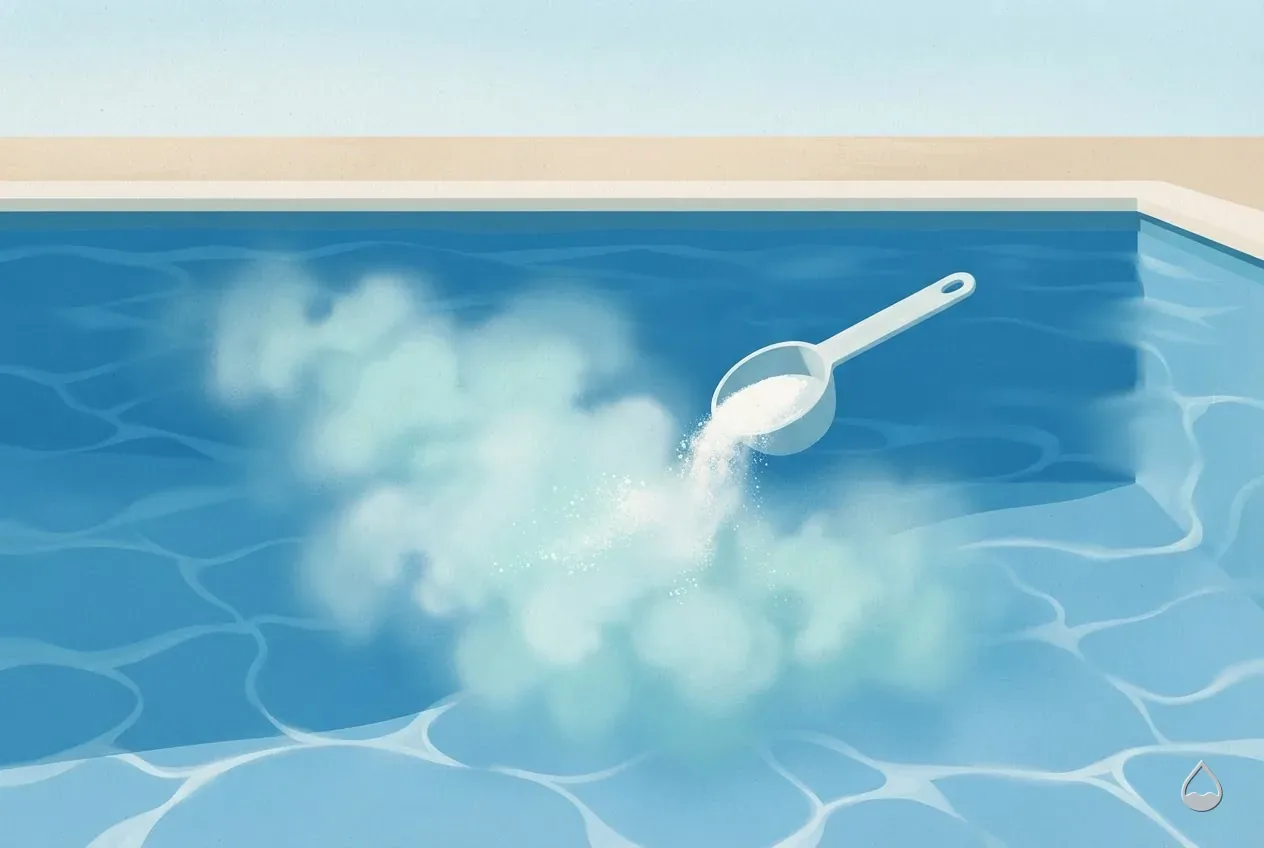
- Broadcast slowly across the deep end. Bicarb is forgiving, but a pile on a vinyl floor still needs brushing out.
- Brush the floor once the visible cloud has gone.
- Re-test after six hours of circulation, not before.
Large corrections can go in one dose — unlike acid, there is no pH crash waiting on the other side. Above about 50 ppm of correction, split it over two days simply so you can see the water clear between.

What to watch afterwards
A pool that needs bicarb repeatedly has a cause, and the cause is usually tablets. Check what is chlorinating the pool: trichlor is acidic and will pull alkalinity down every week, forever. Swapping some of it for liquid chlorine fixes the cause instead of the symptom — and stops stabiliser climbing at the same time.