Sand vs cartridge vs DE: which filter, and why
2026-09-04 · 8 min read
All three filters make water clear. They differ in how fine they go, how much water they waste, how much of your time they take, and how they fail — and the last one is the reason most techs have a preference.
Best overall
Cartridge
Finest practical filtration with no backwash water, at the cost of a soak twice a season.
Best budget
Sand
Cheapest to buy and to own; media lasts years and maintenance is a valve turn.
Best for large pools
DE
The finest water there is, if you accept a recharge after every backwash.
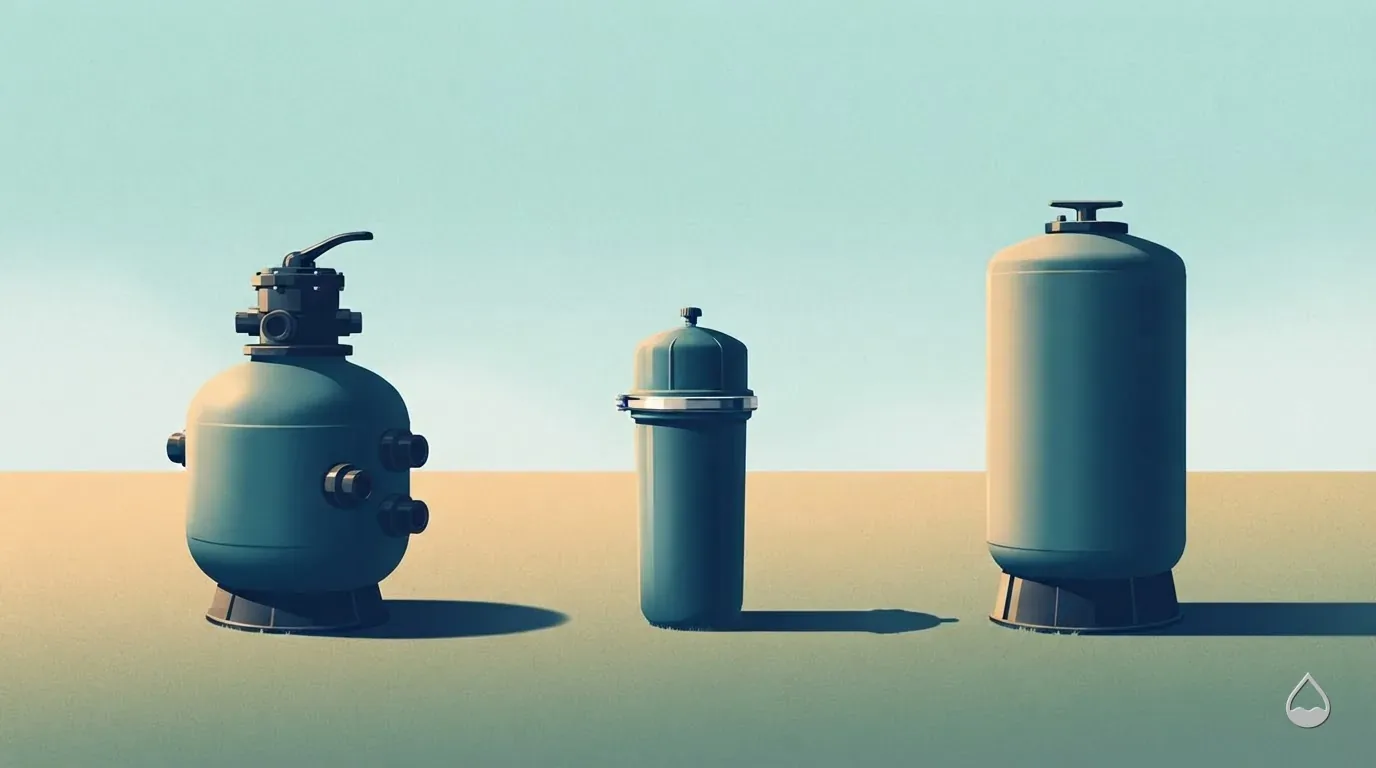
The three types on the things that differ
Our pick — cartridge
| Type | Filtration | Backwash water | Routine work | Media life | Fails as |
|---|---|---|---|---|---|
| Sand | Coarsest of the three | 200–300 gal per backwash | Turn a valve | Several years (no maker interval) | Channelling — normal pressure, dull water |
| Cartridge | Fine | 0 | Rinse monthly, soak twice a season | Until it stops cleaning up (no maker interval) | Torn pleats, visible on inspection |
| DE | Finest | 150–250 gal per backwash | Backwash then recharge every time | Grids 5+ years, DE every backwash | Split grid — DE dust on the floor |
Water cost
Only sand and DE waste water. On a metered supply that is a real line.
Labour cost
Cartridge trades water for your hands. DE trades both for clarity.
Rate matters more
Any of them over-driven filters nothing — check gpm per ft² first.
The number that beats the type
Before the type argument: filtration rate decides more than media does. Push water through a filter faster than its design rate and fine debris passes straight through while the pressure gauge looks normal. The rates are not alike: Hayward rates its sand filters at about 20 gallons per minute per square foot of media, its DE filters at about 2 and its residential cartridges at about 1, so read the label on your own tank. The turnover calculator works your rate out. An over-driven cartridge filters worse than a sand filter run sensibly.
Sand
The default for a reason: cheap, robust, and maintained by turning a valve. The trade is water — every backwash sends a few hundred gallons and its chemistry down the drain — and a failure mode that hides. A channelled bed shows normal pressure and stops filtering, which is why a sand filter that has never been changed is worth suspecting whenever a pool is persistently dull.
Cartridge
No backwash, no waste water, no valve to break, and finer filtration than sand. In exchange you take the element out, hose it, and twice a season soak it — degreaser first, acid only afterwards, in that order or the oils set permanently. On a metered water supply or in a drought region, the water saving alone often decides it.
DE
Diatomaceous earth gives the clearest water of the three, and asks for a recharge after every backwash plus an annual strip-down to inspect the grids. It is the choice for people who care about water clarity as an end in itself, and the wrong choice for anyone who wants the equipment pad to be somebody else’s problem. Handle dry DE with a mask.
Replacing like for like?
Usually yes, unless there is a reason not to: the plumbing, the pad space and the pump were sized around the existing filter. The strongest reasons to switch are water cost (sand or DE to cartridge) and a persistent clarity complaint that survives a proper clean — check the cleaning guide before spending anything.
Buying checklist
- Write the clean-filter pressure on the tank the day you change media.
- Check filtration rate before you blame the filter type.
- On a metered supply, count the backwash water as an operating cost.
- Cartridge: buy a second element so one can dry while the other works.
- DE: inspect grids yearly, not when dust appears on the floor.