Pool cover types: solar, winter and safety covers
2026-09-04 · 6 min read
A cover is the highest-return purchase on a pool and the one most people buy wrong, because the three common types are not competing products — they do different jobs and only one of them is about safety.
Best overall
Safety cover
The only one that stops a child entering the water, and it winterises too.
Best budget
Solar cover
Cheapest thing you can buy that measurably cuts heat and water loss.
Best for large pools
Safety cover with a roller
Mesh sheds rain, anchors take the load, and nothing pools in the middle.
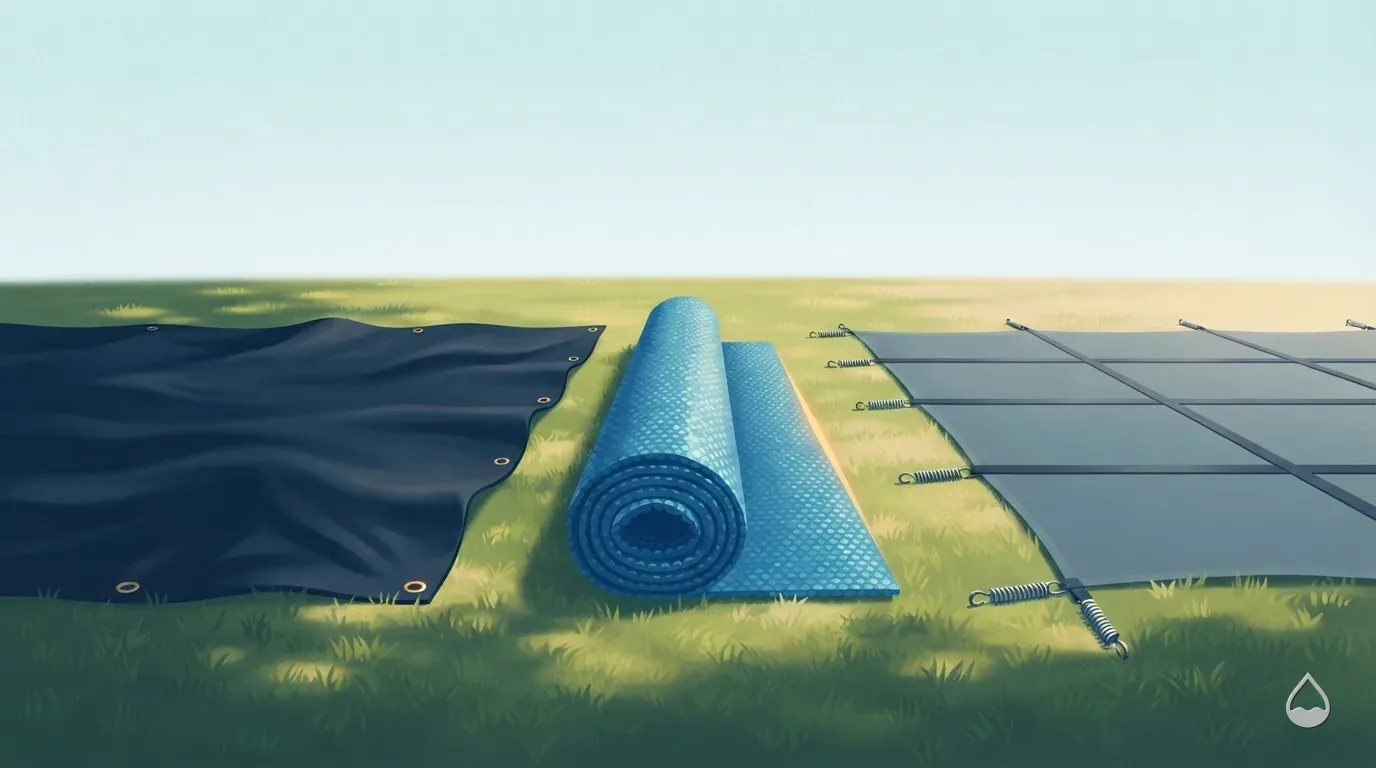
What each cover is actually for
Our pick — safety cover
| Cover | Primary job | Heat | Debris | Safety | Labour |
|---|---|---|---|---|---|
| Solar | Cut evaporation, add heat | Best | Some | None | Daily on and off |
| Winter (solid) | Keep the pool closed and clean | Irrelevant | Total | None | Seasonal, plus pumping water off |
| Winter (mesh) | Same, sheds rain | Irrelevant | Most — fines pass | None | Seasonal, lets water through |
| Safety | Stop entry into the water | Some | Most | Yes, when anchored | Seasonal, needs anchors |
Only one is safety
A solar or winter cover is not a safety device and can make a fall worse.
Evaporation is the loss
Most heat leaves the surface; a floating cover is the cheapest fix.
Anchors matter
A safety cover is only a safety cover when it is tensioned and anchored.
Solar covers
A bubble blanket on the surface does two things: it stops evaporation, which is where most of a pool’s heat goes, and it passes some solar gain into the water. For anyone running a heater it pays for itself faster than any other purchase on the pad.
The cost is handling: it has to come off before swimming and go back on afterwards, and without a roller that is a two-person job nobody keeps doing. Also, left in strong sun on the deck it degrades quickly.
Not a safety device
A floating cover looks like a surface and is not one. A child or animal that goes onto it goes under it — this is the exact scenario safety covers exist to prevent.
Winter covers
Solid winter covers keep everything out, including light, which suppresses algae well. They also collect every drop of rain and snowmelt, so they need a cover pump and someone who will actually use it — a solid cover with a sagging middle is how a pool ends up green in April.
Mesh winter covers let water through and hold back most debris, which removes the pumping chore at the cost of letting fines and some light in. In wet climates that trade is usually worth it.
Safety covers
A safety cover anchors into the deck and is rated to take a person’s weight. It is the only cover in this comparison that addresses the risk that actually matters around a pool, and it doubles as a winter cover. It is also the most expensive and the one that requires installation rather than unrolling.
Pricing is quoted per pool because it depends on shape and anchor count, which is why this page does not print a figure it cannot stand behind. Get two quotes and check the anchors are set into the deck, not into pavers.
What most pools end up with
A solar cover for the season and a safety cover for the winter. That combination covers heat, debris and entry, and it is also the pairing that makes closing and opening straightforward instead of a recovery job.
Buying checklist
- Decide which job you are buying for: heat, debris or entry.
- For a solar cover, budget for a roller or it will not be used.
- For a solid winter cover, buy a cover pump at the same time.
- For a safety cover, check anchors go into the deck itself.
- Wash and dry any cover before it goes into storage.